
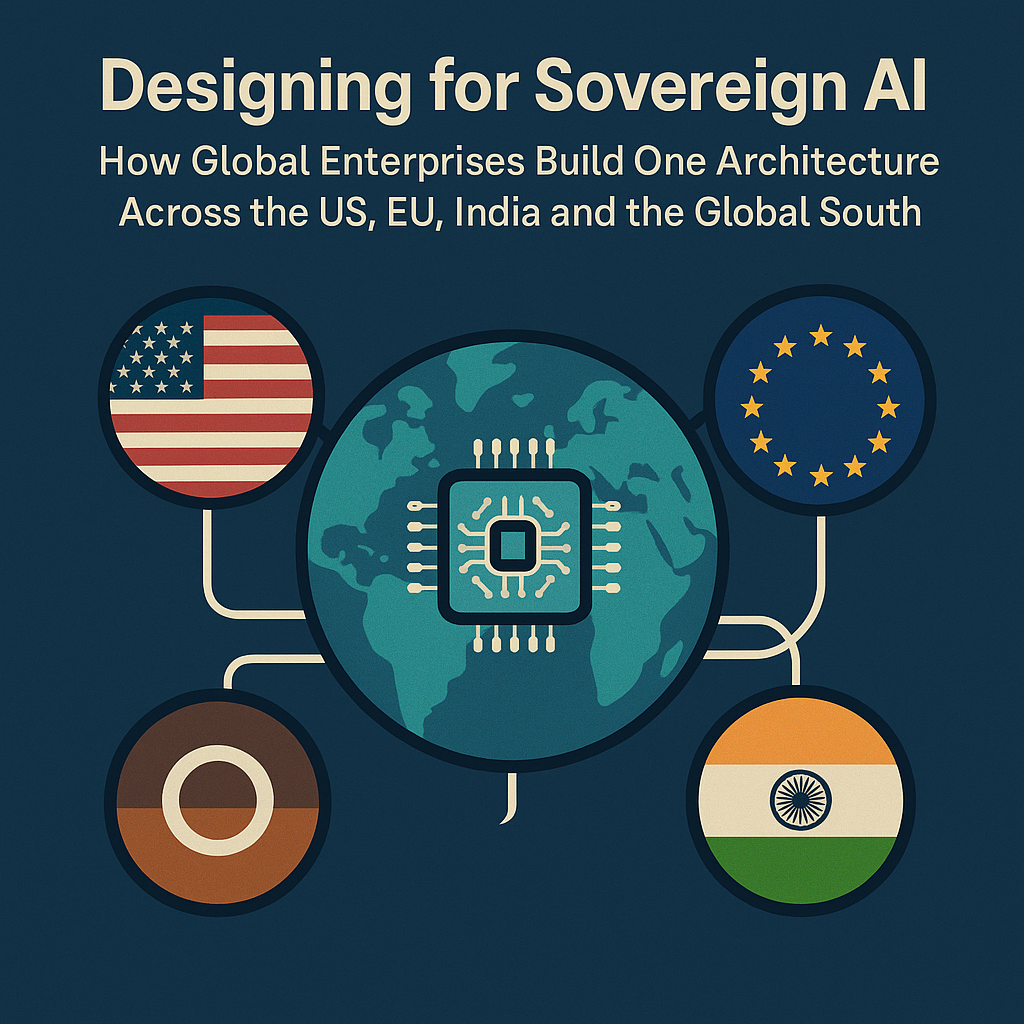
Designing for Sovereign AI: How Global Enterprises Build One Architecture Across the US, EU, India and the Global South
Why “one-size-fits-all” AI is dead — and how CIOs and CTOs can design a sovereign-aware architecture that works across the US, European Union, India, and the wider Global South.
Introduction: When AI Meets Borders
By 2025, “sovereign AI” has jumped from a policy buzzword to a boardroom priority.
- NVIDIA describes sovereign AI as a nation’s ability to produce AI using its own infrastructure, data, workforce, and business networks. (NVIDIA Blog)
- The European Commission has issued a Cloud Sovereignty Framework, turning sovereignty into a concrete design requirement for cloud and AI services. (European Commission)
- India is wiring AI into its national digital backbone through the IndiaAI Mission, the DPDP Act, and a growing push for sovereign cloud and digital public infrastructure. (Press Information Bureau)
- Hyperscalers are responding with EU Data Boundaries, in-country data processing, and sovereign cloud offerings targeted at public sector and regulated industries. (Microsoft)
Yet for a global CIO or CTO, the practical question is brutally simple:
How do we design one AI architecture that works across the US, EU, India, and the wider Global South — without ending up with four completely different tech stacks?
This article is a practical, human-readable guide to designing for sovereign AI:
- what it really means,
- why it is exploding now, and
- how to build a single, flexible architecture that can respect very different rules across regions — and still feel like one coherent platform.
1. What Exactly Is “Sovereign AI”?
Let’s strip away the buzzwords and return to first principles.
At its core, sovereign AI is about answering four questions for each region in which you operate:
- Who controls the infrastructure?
Whose data centres, whose chips, whose cloud contracts, whose administrators? - Where does data live, and who can touch it?
Data residency, cross-border data flows, and the legal reach of foreign governments. - Who owns and governs the AI models?
Who can train, fine-tune, or export a model — and under which laws and licences? - Whose values and laws shape AI behaviour?
Local languages, culture, safety policies, content restrictions, sectoral regulations, and compliance norms.
Different regions interpret sovereignty through different lenses:
- NVIDIA’s definition emphasizes national capability: local infrastructure, domestic datasets, a skilled AI workforce, and a home-grown business ecosystem. (NVIDIA Blog)
- The European view leans heavily on data and AI sovereignty — ensuring that data and AI services remain under EU jurisdiction and are shielded from extra-territorial claims. (European Commission)
- India’s narrative links AI to technology sovereignty and AI democratization — domestic compute, open-source-first approaches, inclusion of Indian languages, and strict adherence to data protection (DPDP). (IndiaAI)
For a global enterprise, sovereign AI is not just a government programme or a vendor slide. It is a hard design constraint:
“Can we build AI systems that stay compliant, resilient, and trusted — even as laws, suppliers, and geopolitics change?”
2. Why Sovereign AI Is Exploding Now
Three structural forces have converged to make sovereignty an architectural concern instead of a footnote.
2.1 Regulation Is Becoming Architecture
- In the European Union, GDPR, the coming EU AI Act, and the new Cloud Sovereignty Framework are pushing organisations to keep sensitive data and AI services under EU law and in EU-based infrastructure. (European Commission)
- In India, the Digital Personal Data Protection (DPDP) Act and the IndiaAI Mission embed consent, purpose limitation, and harm prevention into the way AI systems must be trained and deployed. (Press Information Bureau)
Regulation is no longer a static PDF that legal teams read once a year. It now literally decides:
- which regions can host your workloads,
- which APIs you are allowed to call, and
- which models are you allowed to train and move?
2.2 Hyperscalers Are Re-Drawing the Map
Cloud providers are reshaping their platforms around sovereignty:
- EU Data Boundaries promise that certain customer data and processing stay inside the EU and EFTA. (Microsoft)
- Sovereign cloud offerings add stricter controls over admin access, logging, encryption, and legal jurisdiction, often co-designed with governments. (BCG)
This is a huge opportunity: you can now “buy” large parts of sovereign infrastructure.
But it also fragments your AI landscape into multiple sovereign zones that must still work together.
2.3 Nations See AI as Critical Infrastructure
From Europe’s Gaia-X federated cloud initiative (gaia-x.eu) to India’s push for sovereign cloud and digital public infrastructure, (Express Computer) AI is being treated like:
roads, ports, or power grids — essential national infrastructure.
Analysts now talk about sovereign cloud and sovereign AI as a multi-hundred-billion-dollar market category over the next decade. (BCG)
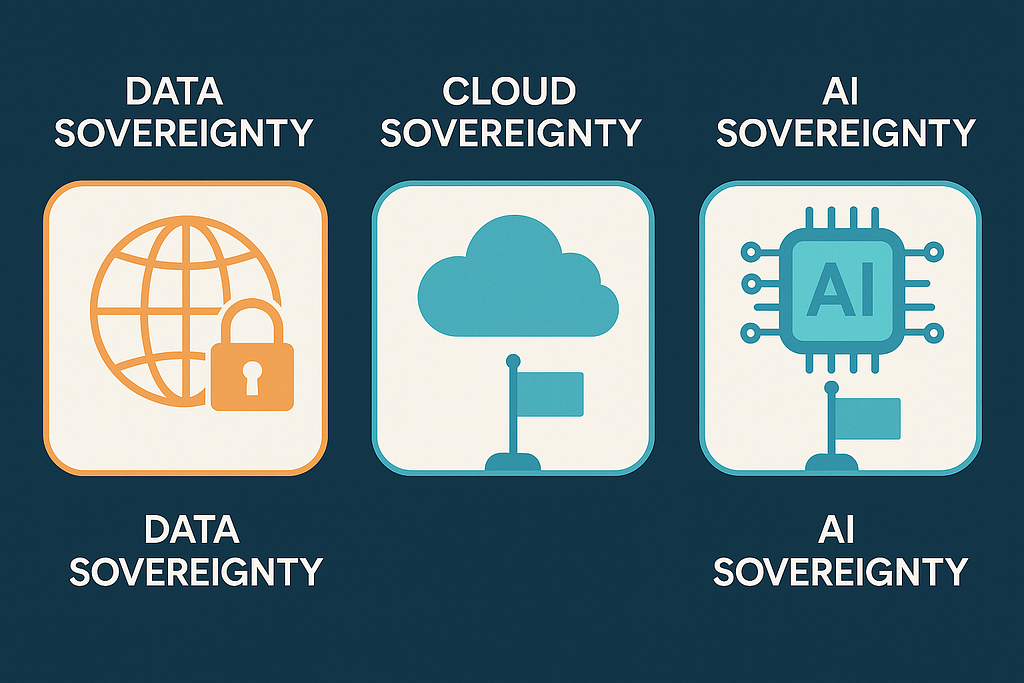
3. Data Sovereignty vs Cloud Sovereignty vs AI Sovereignty
These terms are often used interchangeably. In architecture, that’s dangerous. You need sharp definitions.
3.1 Data Sovereignty
Where is data stored, and which laws apply to it?
Example:
A European retailer’s customer data must remain under EU jurisdiction even if the SaaS vendor is American. Non-compliance can trigger regulatory fines and reputational damage. (Oracle)
3.2 Cloud Sovereignty
Who operates the cloud infrastructure, and who can legally access it?
Example:
An EU public-sector body may require that only EU-based personnel administer its cloud, in EU data centres, with strong contractual and technical protections against foreign government access. (European Commission)
3.3 AI Sovereignty
Who controls the full AI value chain — data, models, infra, and policies — in line with local values and interests?
Example:
India is building local AI models in Indian languages, trained on public sector and DPI data, running on domestic compute, governed by Indian law — yet still leveraging global open source and commercial tools. (IndiaAI)
For a global enterprise architect, the message is simple:
- Data sovereignty → where the bits live
- Cloud sovereignty → who runs the stack and under whose law
- AI sovereignty → who shapes the behaviour, lifecycle, and accountability of the models
A sovereign AI architecture must connect all three layers.
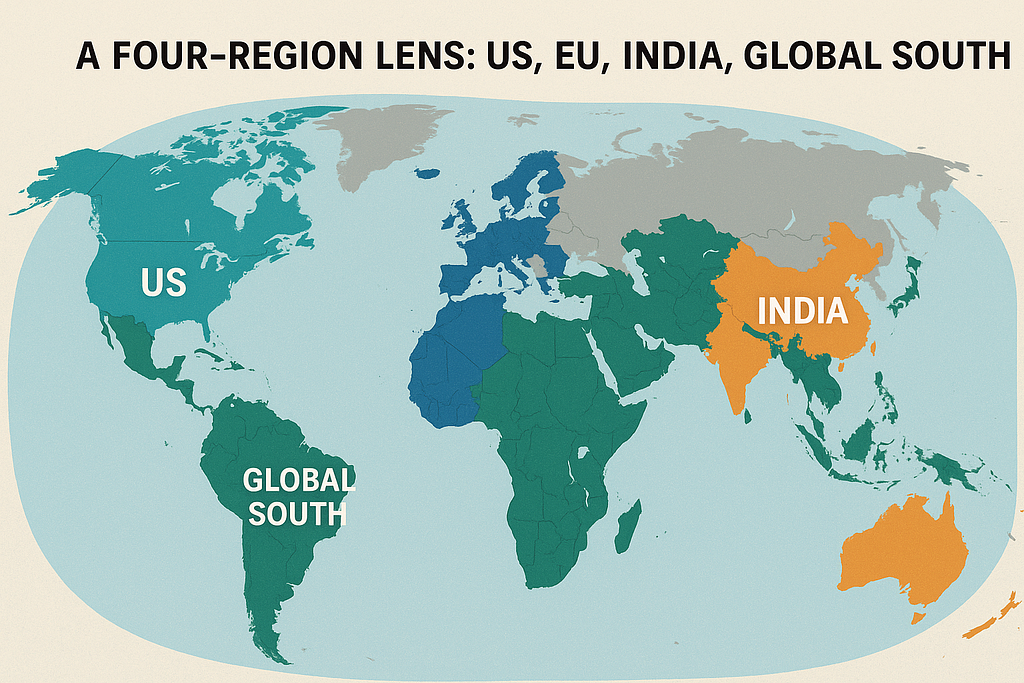
4. A Four-Region Lens: US, EU, India, Global South
Picture yourself as the CIO of a global bank or consumer goods company operating in:
- the United States,
- the European Union,
- India, and
- the broader Global South (GCC, LATAM, Africa, ASEAN, etc.).
You want one AI platform, one brand, one user experience.
The reality: each region pulls your architecture in a different direction.
4.1 United States
- More flexible cross-border data flows (relative to the EU).
- Strong focus on innovation, productivity, and competition.
- Home base for many hyperscalers and model providers.
Implication:
The US often becomes your innovation lab — but it can no longer be the single global hub for all data and models.
4.2 European Union
- Strong data protection (GDPR) and the upcoming EU AI Act.
- Clear shift toward digital and cloud sovereignty, with initiatives like Gaia-X and EU Sovereign Clouds. (gaia-x.eu)
Implication:
EU workloads frequently need EU-only hosting, limited non-EU admin access, and robust legal insulation from extra-territorial jurisdiction.
4.3 India
- DPDP Act sets clear expectations on consent, purpose limitation, and liability for misuse. (Press Information Bureau)
- IndiaAI Mission and national compute initiatives push for AI capabilities that are inclusive, local-language friendly, and globally competitive. (IndiaAI)
Implication:
India’s workloads must align with DPDP and increasingly favour India-based data centres and sovereign clouds, particularly for citizen services and public-sector data.
4.4 The Global South (Beyond India)
- Countries in the Gulf, Africa, Latin America, and Southeast Asia are investing in national data centres, sovereign cloud partnerships, and local AI ecosystems. (BCG)
- Regulatory maturity varies, but the common message is:
“Keep critical data and models under our law, within our borders.”
Implication:
Expect a patchwork of rules — but a shared desire for local control plus global interoperability.
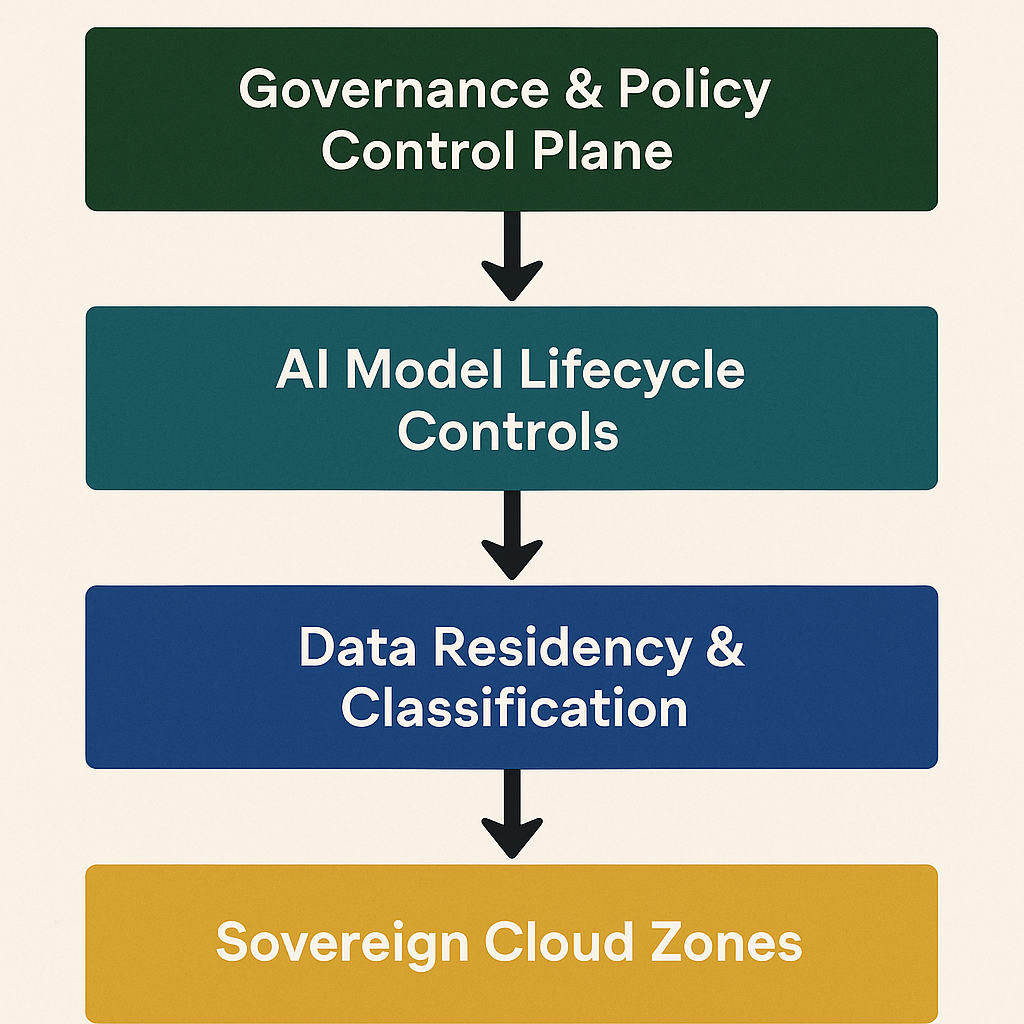
5. The Building Blocks of a Sovereign AI Architecture
So how do you design one architecture that respects all of this?
Think in layers, not isolated projects.
5.1 Layer 1 — Sovereign Cloud Zones
Create logically distinct zones inside your global architecture:
- EU Sovereign Zone — runs on EU-based data centres and services that meet EU sovereignty and AI data boundary requirements. (Microsoft Learn)
- India Sovereign Zone — runs in India-based data centres, aligned with DPDP and India’s digital public infrastructure. (Express Computer)
- US & Global Zone — where sovereignty constraints are lighter and cross-region training is more feasible.
Concrete example — Customer Support AI
- EU customer chats → processed in the EU zone using EU-hosted models.
- Indian customer chats → handled entirely in the India zone.
- Other regions → served from a global cluster (or regional zones in GCC, Africa, LATAM).
To the customer, it is one consistent support experience.
Under the hood, the system is zone-aware.
5.2 Layer 2 — Data Residency and Classification
Instead of a single global data lake, move to classified, region-aware data pools:
- Red data — highly sensitive; must never leave the region (e.g., health records in the EU, critical financial data).
- Amber data — aggregated or anonymised; can move with strict controls.
- Green data — public or synthetic; can move freely.
Then design your AI accordingly:
- Red-data models — trained and served locally, never exported.
- Amber-data models — trained locally, but you may share model parameters, not raw data (e.g., federated learning, split learning). (gaia-x.eu)
- Green-data models — trained globally, reused widely.
5.3 Layer 3 — AI Model Lifecycle Controls
For each region, you should know:
- Where can models be trained?
US-only, EU-only, India-first, or global? - Where can they be hosted?
Sovereign zones, global zones, or both? - Where can they be used?
Can an EU-trained model serve US users? Under what conditions?
A common pattern:
- A global base model trained primarily on green and amber data.
- Regional adapters / fine-tunes in EU, India, GCC, etc., with region-specific data and safety policies.
- Policy layers that apply local compliance, content filters, and language settings at inference time.
5.4 Layer 4 — Governance & Policy Control Plane
This is the “brain of the brain”.
You need a centralised but policy-aware control plane that:
- Knows which data is allowed where.
- Enforces where each model can run.
- Decides where logs must be stored (local vs global).
- Integrates with DPDP, GDPR, sectoral rules, and internal risk frameworks.
Think of it as an air traffic controller for AI:
Every training job and inference call must pass through this layer, where it is checked against the right sovereignty rules before being allowed to “take off”.

6. A Story: Designing a Global Customer Support Copilot
Let’s bring this down to earth.
Imagine you’re a multinational telecom provider. You want a single customer support copilot that:
- Works across the US, EU, India, and several African countries,
- Handles 25+ languages,
- Can access bills, payments, and complaint history.
A sovereign-ready design might look like this.
Step 1 — Global Knowledge
- Generic FAQs, device manuals, tariff explanations, and public documentation go into a global “green data” pool.
- A global foundation model (open source + commercial) is trained or fine-tuned on this pool.
Step 2 — Regional Data
- EU customer records → stored and processed in the EU Sovereign Zone.
- Indian customer records → stored and processed in the India Sovereign Zone.
- African and Middle Eastern records → stored in regional zones or specific national clouds, depending on regulations.
Step 3 — Regional Brains
The global model is specialised separately in each zone:
- EU adapter with EU languages and strict European privacy policies.
- India adapter with Hindi and regional languages, plus DPDP-aware logic (for consent and purpose).
- Africa / Middle East adapters with local languages, tariff plans, and local regulatory rules.
Step 4 — Routing Logic
- When a user opens the support app, the system identifies their country/region.
- The request is routed to the appropriate regional AI stack.
- The user sees one brand, one tone of voice — but each interaction is processed under local law and local infrastructure.
If tomorrow:
- The EU is tightening cross-border transfer rules even further, or
- India mandates that certain AI logs must never leave the country,
You don’t have to redesign the entire copilot.
You tune zone configurations and policies in your control plane, rather than rebuilding the product.
That is the practical power of designing for sovereign AI.
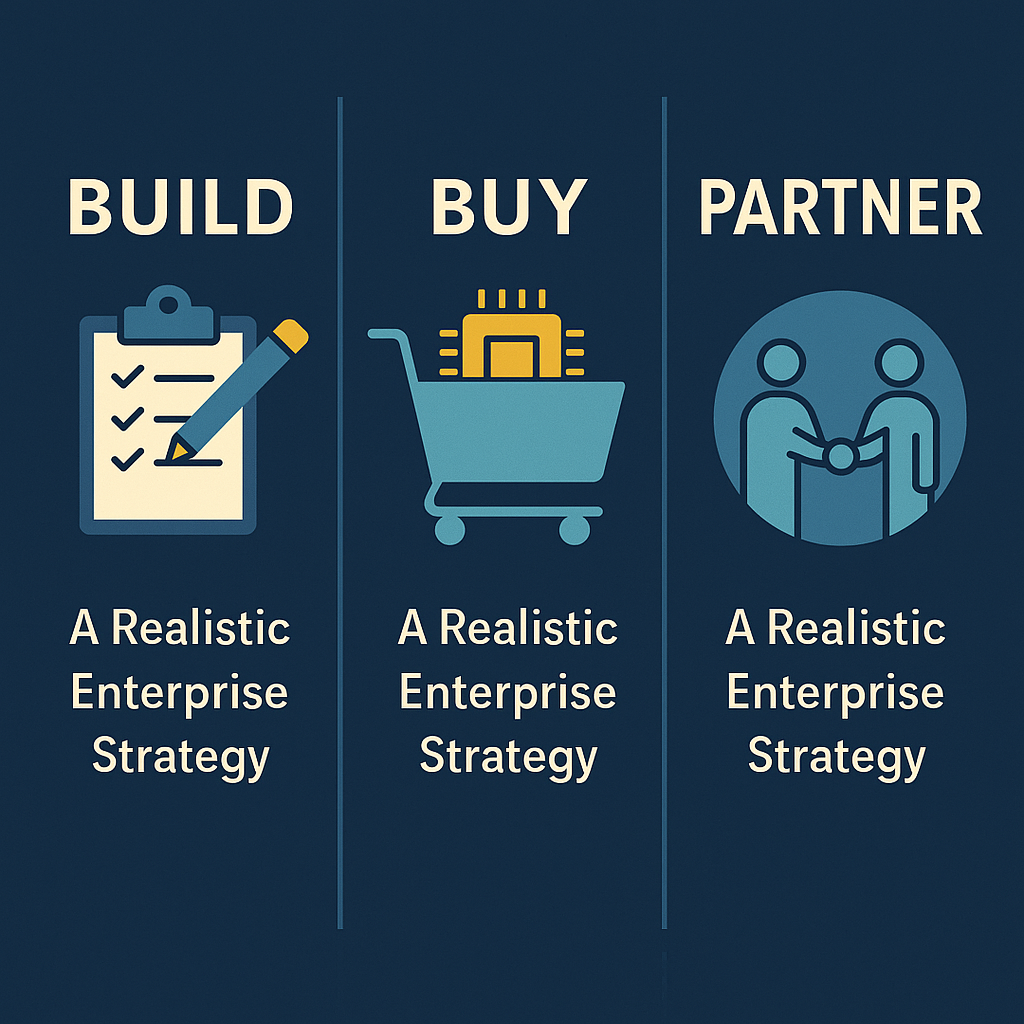
7. Build, Buy, Partner: A Realistic Enterprise Strategy
No serious enterprise is going to build sovereign AI from scratch end-to-end. Nor should you.
Most organisations will combine three moves.
7.1 Build: Your Core “Sovereign IP”
You should build and own:
- Your policy engine and governance workflows.
- Your data classification and residency strategy.
- Integrations with ERP, CRM, core banking/core systems, and your security stack.
This is your real sovereign AI IP — not the GPUs, but the rules and logic that keep your AI compliant and trustworthy.
7.2 Buy: Sovereign-Aware Infrastructure
You will buy or subscribe to:
- Sovereign and in-country cloud offerings from global hyperscalers and regional providers. (BCG)
- Managed services for:
- Key management and HSMs,
- Logging and observability,
- Compliance tooling and audit trails.
This lets you stand on the shoulders of dedicated cloud and security teams, instead of reinventing the infrastructure.
7.3 Partner: National and Regional Ecosystems
You will partner with:
- Local AI labs and universities (e.g., India’s sovereign AI and DPI ecosystem, EU startups building localisation-first AI). (IndiaAI)
- Regional cloud and telecom providers in GCC, Africa, LATAM, and ASEAN.
This gives you local nuance and legitimacy, which is just as crucial as technical capability when you talk to regulators and citizens.
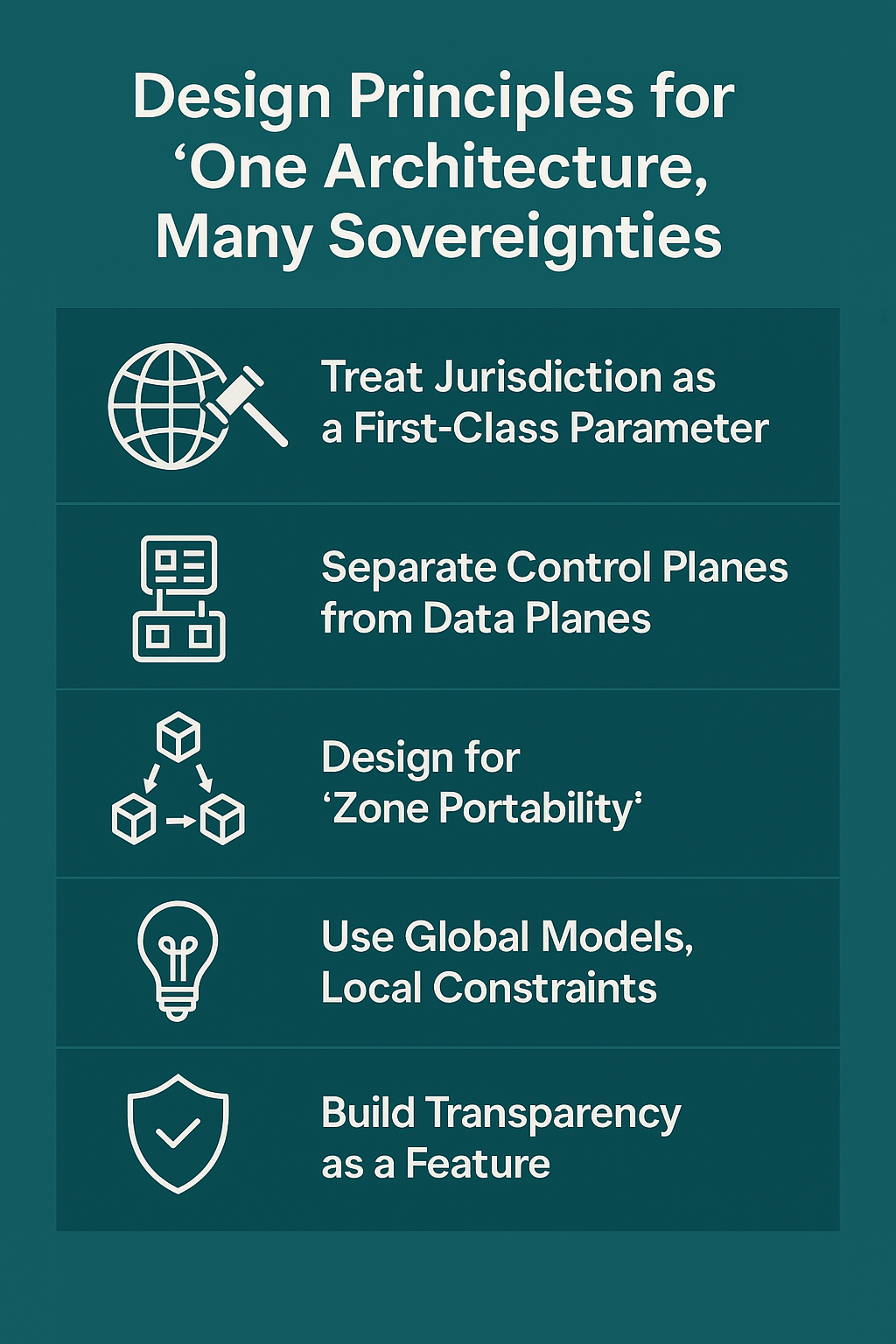
8. Design Principles for “One Architecture, Many Sovereignties”
Here is a practical checklist you can use inside your architecture and strategy teams.
8.1 Treat Jurisdiction as a First-Class Design Parameter
Move beyond “Where is compute cheapest?” to:
“Which jurisdiction should own this workload, and what does that imply for infra, models, and data?”
Reflect this in:
- Environment naming (e.g., EU-sovereign-prod, in-sovereign-prod).
- CI/CD pipelines that deploy per region, not globally by default.
- Access policies and audit logs that are region-aware.
8.2 Separate Control Planes from Data Planes
- Control plane — policies, configuration, orchestration logic.
- Data plane — actual training data, embeddings, model weights, logs.
You can centralise parts of the control plane for consistency, but data planes must remain regional where sovereignty demands it.
8.3 Design for “Zone Portability”
Assume that in 3–5 years:
- Regulations will evolve,
- New sovereign zones will emerge,
- Some zones may be merged or retired.
Your AI workloads should:
- Be containerised, infrastructure-as-code driven, and movable between compliant zones.
- Avoid baking region-specific rules deep into model weights when they can live in policies, prompts, and configuration layers.
8.4 Use Global Models, Local Constraints
Aim for:
- Global patterns for architecture, observability, security, and MLOps tooling.
- Local specialisations for:
- Data sources and training sets,
- Safety and content policies,
- Languages and prompts,
- Regulatory requirements.
This way, you get economies of scale without sacrificing local compliance and trust.
8.5 Build Transparency as a Product Feature
In a sovereign AI world, audits will be normal:
- Be prepared to show who trained what, where, and with which data.
- Maintain traceability from:
- Raw data → features / embeddings → model versions → deployments.
Transparency is not only for regulators.
It builds confidence with your leadership, customers, and partners — and makes it easier to recover when something goes wrong.
9. The Global South Opportunity
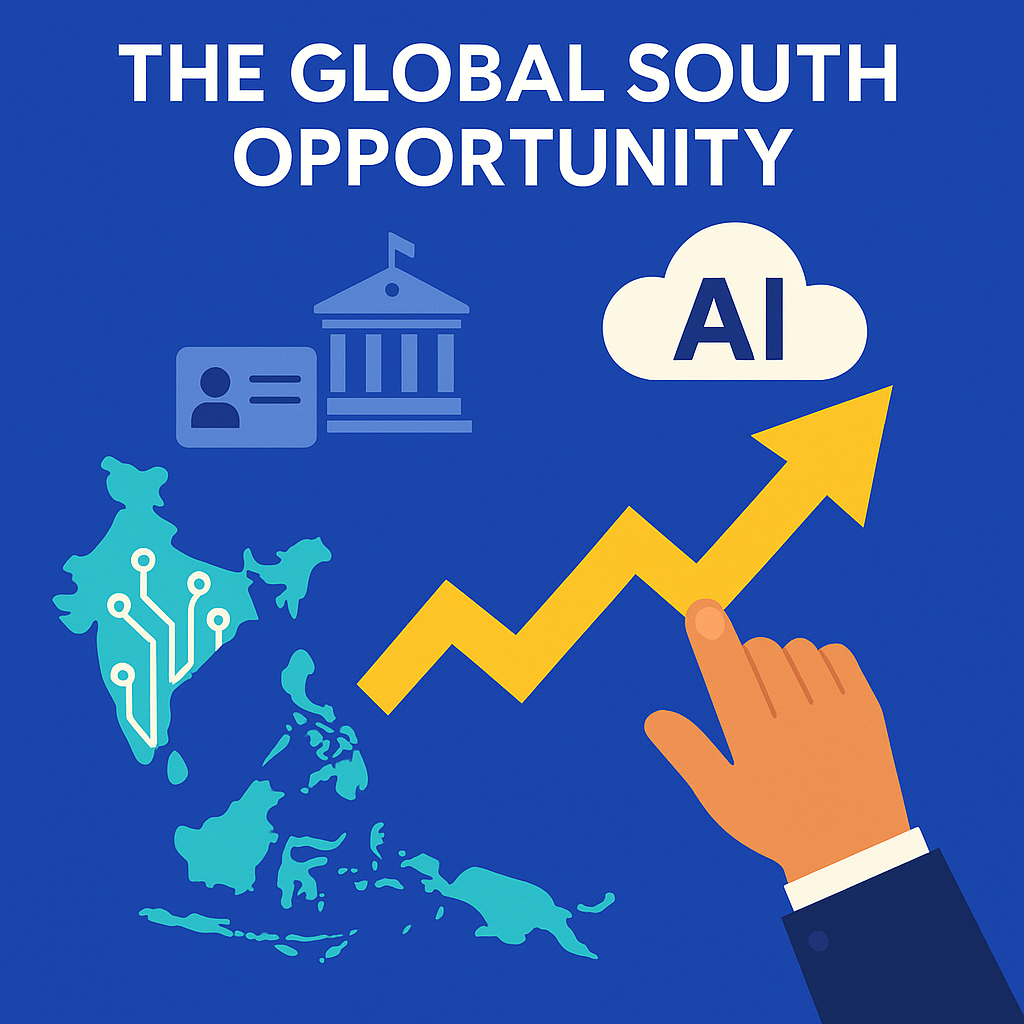
For many countries in the Global South, sovereign AI is not just about protection — it is about leapfrogging:
- Combining sovereign cloud with digital public infrastructure (UPI, national ID, health stacks) to build AI systems tuned to local realities rather than imported assumptions. (Express Computer)
- Avoiding over-dependence on a single foreign platform, while still tapping into open source and global best-of-breed.
For global enterprises, this opens a strategic path:
- Design AI systems that respect sovereignty by default, not as a bolt-on fix.
- Position yourself as a trusted development partner to governments and regulators — not just another vendor selling a black-box platform.
Done well, sovereign AI becomes a competitive advantage in emerging markets, not just a compliance hurdle.
10. Conclusion: Sovereignty as a Feature, Not a Bug
Designing for sovereign AI can feel messy: multiple laws, multiple clouds, multiple zones, multiple regulators.
But the organisations that see sovereignty as a feature of their architecture — instead of a problem to be patched later — will gain three long-term advantages:
- Resilience
Less exposed to regulatory shocks, geopolitical tensions, or sudden shifts in cloud policy. - Trust
Easier approvals from regulators and boards, stronger brand in sensitive markets, and greater comfort among customers whose data you hold. - Local Relevance at Global Scale
AI that genuinely understands local languages, norms, and rules — without losing the power of global innovation and shared models.
In other words:
The future global AI leaders won’t be the ones who build the biggest single model. They’ll be the ones who design the smartest sovereign-aware architecture.
If you are a CIO, CTO, or policy leader, the right question is no longer: “Should we care about sovereign AI?”
The real question is:
“Is our AI architecture ready for a world where every region demands its own form of sovereignty — and still expects a seamless, global experience?”
Glossary
Sovereign AI
The capability of a nation or region to develop and deploy AI using its own infrastructure, data, workforce, and business ecosystem, under its own laws and values.
Data Sovereignty
The principle that data is subject to the laws and governance structures of the country or region where it is collected and stored (e.g., EU GDPR, India’s DPDP).
Cloud Sovereignty
The requirement that cloud infrastructure and operations — including admin access and legal jurisdiction — remain under local or regional control.
AI Sovereignty
End-to-end control over the AI value chain (data, models, infra, and policies) in line with local regulations and societal values.
DPDP Act (India)
India’s Digital Personal Data Protection Act governing how personal data is collected, processed, and stored, with a strong emphasis on consent and purpose limitation.
EU Data Boundary
A Microsoft initiative to store and process EU and EFTA customer data within the EU geographic region, reducing cross-border data flows.
Digital Public Infrastructure (DPI)
Foundational digital systems like Aadhaar, UPI, health stacks, and identity/payment rails that power public services and private innovation in countries such as India.
Federated Learning
A method of training AI models across multiple data locations without moving raw data out of its region, improving privacy and compliance.
Sovereign Cloud
Cloud services specifically engineered to comply with national sovereignty requirements, including local data residency, legal jurisdiction, and controlled admin access.
Global South
A broad term for emerging and developing economies in regions such as South Asia, Africa, Latin America, and parts of Southeast Asia and the Middle East.
FAQ: Sovereign AI for Global Enterprises
Q1. Is sovereign AI only relevant for governments and public sector?
No. If you operate in regulated industries (finance, healthcare, telecom, energy) or across multiple regions (US, EU, India, GCC, Africa, LATAM), sovereign AI is already a design constraint. Government rules will shape your cloud choices, data flows, and AI models.
Q2. Do I need separate AI platforms for each region?
Not necessarily. The goal is one global architecture with multiple sovereign zones — shared patterns for models and tooling, but region-specific zones for data, hosting, and policies.
Q3. Will sovereign AI slow down innovation?
It can, if treated purely as a compliance burden. But if you design for it upfront, sovereignty becomes a way to unlock new markets (EU, India, Global South) where trust and local alignment are critical.
Q4. How do I know where to start?
A pragmatic sequence:
- Map your current data flows and jurisdictions.
- Classify data (red / amber/green).
- Identify critical workloads (customer support, risk decisions, citizen services).
- Design a minimal set of sovereign zones and start with one or two high-impact use cases.
Q5. Does sovereign AI mean I cannot use US-based hyperscalers?
Not at all. Most sovereign strategies today are co-created with hyperscalers, regional providers, and local partners. The key is to ensure contracts, technical controls, and model governance align with local laws and digital sovereignty goals.
Q6. How does this relate to AI safety and alignment?
Sovereign AI sits alongside safety:
- Safety asks “Is the model safe and reliable for people?”
- Sovereignty asks “Is the model compliant, controllable, and legitimate under our local laws and values?”
A mature AI strategy needs both.
References & Further Reading
- NVIDIA — What Is Sovereign AI?
Explains sovereign AI as a nation’s ability to produce AI using its own infrastructure, data, workforce, and business networks. (NVIDIA Blog) - European Commission — Cloud Sovereignty Framework & Digital Sovereignty Initiatives
Official EU documents detailing sovereignty objectives for cloud providers and AI services. (European Commission) - IndiaAI Mission & DPDP Act
Government releases and commentary on India’s AI Mission, technology sovereignty, and the Digital Personal Data Protection Act. (Press Information Bureau) - Microsoft — EU Data Boundary for the Microsoft Cloud
Documentation on how Microsoft keeps EU customer data within the EU/EFTA region. (Microsoft) - Gaia-X — Federated, Secure Data Infrastructure for Europe
Initiative aiming to build a secure, federated ecosystem for European data and cloud services. (gaia-x.eu) - BCG & Industry Reports on Sovereign Cloud and AI
Analyses on sovereign cloud strategies, national data security, and the economics of cloud and AI infrastructure. (BCG) - Express Computer & Indian Policy Articles on Sovereign Cloud + DPI
Guest articles exploring how sovereign cloud and digital public infrastructure can become the backbone of India’s AI economy. (Express Computer)
Together, these sources show why designing for sovereign AI is not a passing fad — it is the new operating reality for any organisation that wants to build trusted, global-scale AI systems.
A message from our Founder
Hey, Sunil here. I wanted to take a moment to thank you for reading until the end and for being a part of this community. Did you know that our team run these publications as a volunteer effort to over 3.5m monthly readers? We don’t receive any funding, we do this to support the community.
If you want to show some love, please take a moment to follow me on LinkedIn, TikTok, Instagram. You can also subscribe to our weekly newsletter. And before you go, don’t forget to clap and follow the writer️!
Designing for Sovereign AI: How Global Enterprises Build One Architecture Across the US, EU, India… was originally published in Stackademic on Medium, where people are continuing the conversation by highlighting and responding to this story.
PakarPBN
A Private Blog Network (PBN) is a collection of websites that are controlled by a single individual or organization and used primarily to build backlinks to a “money site” in order to influence its ranking in search engines such as Google. The core idea behind a PBN is based on the importance of backlinks in Google’s ranking algorithm. Since Google views backlinks as signals of authority and trust, some website owners attempt to artificially create these signals through a controlled network of sites.
In a typical PBN setup, the owner acquires expired or aged domains that already have existing authority, backlinks, and history. These domains are rebuilt with new content and hosted separately, often using different IP addresses, hosting providers, themes, and ownership details to make them appear unrelated. Within the content published on these sites, links are strategically placed that point to the main website the owner wants to rank higher. By doing this, the owner attempts to pass link equity (also known as “link juice”) from the PBN sites to the target website.
The purpose of a PBN is to give the impression that the target website is naturally earning links from multiple independent sources. If done effectively, this can temporarily improve keyword rankings, increase organic visibility, and drive more traffic from search results.
Jasa Backlink
Download Anime Batch